


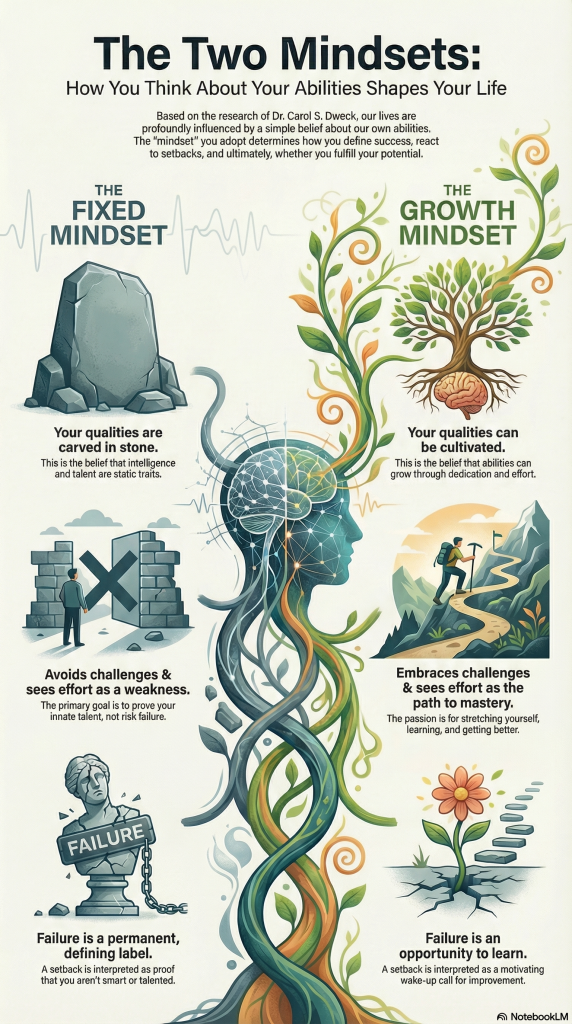
The core theories of mindset, initially studied in educational settings by Dweck and her colleagues, explain far more than just classroom performance; they affect nearly all aspects of life.
The Entrepreneurial and Agile Approach:
The growth mindset is vital in specialised domains such as business and innovation:
- Entrepreneurial Mindset: To launch new ventures and identify exciting opportunities, a person needs an entrepreneurial mindset. This perspective is crucial because it includes the fundamental belief that failure is something to build on. It is nurtured through the practice of self-leadership, creativity, and improvisation.
- Agile Mindset: In organizational contexts, merely following the technical process of an agile workflow is not enough; true success requires shifting the way individuals and organizations think. An organization must adopt a growth mindset to be truly agile, expecting change and committing to continuous learning. This requires moving from the “I” (individual goals and knowing the answers) to the “we” (pooling thinking, finding hypotheses to test and collaborating.
For agile ways of working, psychological safety is a critical element, as it allows for transparency, permitting problems to be acknowledged and tackled rather than buried (like a “watermelon project” that appears green outside but is red inside).
Mindset and Mental Attitude
The mindset framework relates strongly to an individual’s internal interpretation of events and ability to cope with emotional distress:
- Framing the Monologue: Mindsets frame the “running account” or internal monologue taking place in people’s heads. The fixed mindset centres on judging (“This means I’m a loser”), while the growth mindset leads to a growth-oriented monologue focused on learning and becoming better
- Coping with Distress: People with a fixed mindset tend to have higher levels of depression, often because they ruminate over setbacks that imply incompetence. In contrast, those with a growth mindset, even when distressed, become more motivated and confront problems constructively
- Cognitive Restructuring: The development of Cognitive Behavioural Therapy (CBT) was informed by ancient philosophies such as Stoicism, sharing the goal of analysing beliefs to alleviate distress. Mindset offers a direct route to this: it shifts individuals from a “judge-and-be-judged framework” to a “learn-and-help-learn framework”. Cognitive restructuring is a formal process involving steps to challenge negative thought patterns and find more balanced thoughts
By understanding that abilities can be cultivated (a growth mindset), individuals gain the motivation and belief to tackle challenging situations, even when they start without full confidence or encounter failure. This transformation unleashes effort and potential, moving individuals from attempting to prove their worth to embracing the passion for stretching themselves and continually getting better.
